
Checking Criminal History in High Springs
Begin by deciding what event or outcome needs proof. HSPD is the right first custodian for a report its officers created. The Alachua County Sheriff’s Office handles the county jail record after an adult custodial arrest. The Alachua County Clerk records a prosecution if the State Attorney files a case. FDLE’s repository reaches beyond one city and compiles criminal-history events reported across Florida. Keeping those roles separate prevents a common error: treating one police report as a complete record of a person’s history.
- Call High Springs Police at (386) 454-7319 and identify the specific city police report needed.
- Give the report or case number when known, plus the event date, location, involved party, and preferred delivery method.
- Use the ACSO current-inmate search when the immediate question is whether a person remains in county custody.
- Search the Alachua County Clerk for filed charges, docket events, disposition, and sentence.
- Use the FDLE Florida criminal-history channel for a statewide record rather than asking HSPD to create one.
This order follows the way High Springs records are actually divided. It also gives each custodian enough detail to distinguish the event from another report involving a similar name.
Call Ahead for High Springs Records
High Springs offers a useful access step before anyone drives to the police department. The city’s official records instructions tell requesters to call (386) 454-7319 in advance. Records staff can locate the item and prepare it before a visit. The department also tries to send records by electronic means when possible, which may remove the need for a trip. That call is not merely a courtesy. It is a direct city records channel and is especially useful when a file must be found by date or report number.
State the record type at the start of the call. A request for an incident report, arrest report, or Internal Affairs copy should be described as such. Provide a date and location, the involved party’s name, and any case or report number already known. Ask whether the releasable copy can be sent electronically and whether any fee or identity condition applies. The source material did not publish a general High Springs fee schedule, so the department should confirm cost before production.
Note: A short, well-scoped request is easier to locate and less likely to be confused with a statewide background-history request.
High Springs Police Department Records
The High Springs Police Department is the custodian for reports made by its officers within the city. Those records can include an incident narrative, arrest-related paperwork, and other releasable local police material. A report may exist even when no arrest followed. Likewise, an HSPD arrest report documents the officer’s asserted legal grounds and the alleged offenses, not the later court result.
The official HSPD page provides a view of the department that keeps these local files.
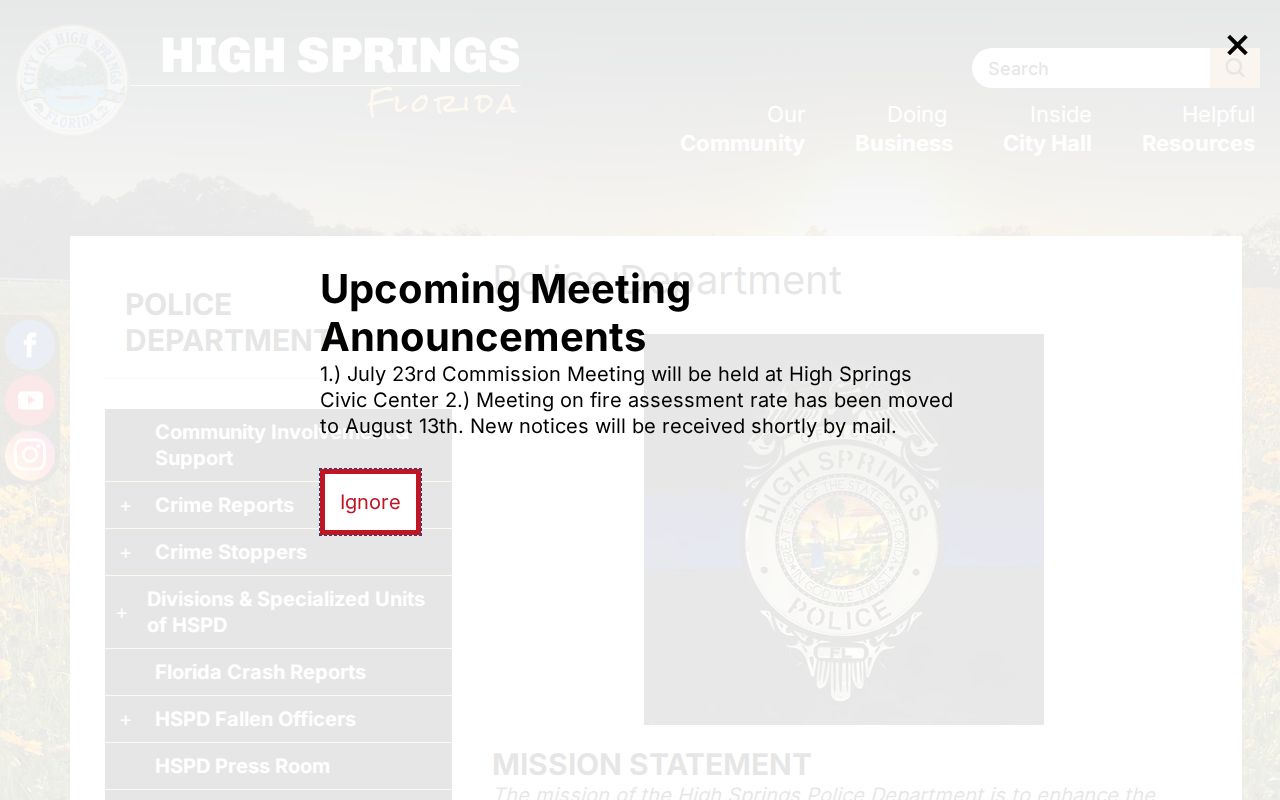
The department image helps identify the city-level starting point, while the record itself must still be requested through HSPD’s call-ahead process.
High Springs police records do not automatically include jail processing, a prosecutor’s filing choice, or the final judgment. Those later entries belong to county systems. If an item was created by another agency, such as ACSO or Florida Highway Patrol, HSPD is not the proper custodian merely because the person lives in High Springs.
High Springs Report Request Details
A focused set of facts helps HSPD locate the correct report and determine what can be released. A name alone may be too broad. Use the city report number if it is printed on a prior document, then add the event details that confirm the match.
| Record Type | Identify the police, incident, arrest, or Internal Affairs record being sought. |
|---|---|
| Report Number | Provide the HSPD case or report number when available. |
| Event Details | Give the date and location tied to the High Springs event. |
| Involved Party | Supply the name connected to the report to narrow the search. |
| Delivery | Provide a usable delivery route and request electronic delivery when suitable. |
Ask for an existing record rather than a broad explanation or a new compilation. If part of the file is exempt, request the releasable redacted portion and the legal basis for anything withheld. That approach fits Florida’s public-record framework and gives the custodian a clear task.
High Springs Arrests and Bookings
An adult taken into custody by HSPD is routed to the Alachua County Jail rather than kept in a separate High Springs jail system. HSPD retains the city arrest or incident report. ACSO Booking Support creates the jail entry, which may include the booking number, identifiers, charge and hold data, bond information, and release status. These two records arise from the same event but serve different purposes.
For recent custody, use the official ACSO current-inmate search. It accepts a last name, first name, or booking number, including incomplete name entries. The result is a present-custody roster, not a complete High Springs arrest archive. A person may not appear because release processing finished, a transfer occurred, or the name was entered differently. Historical booking material may require a records request.
The next county event is first appearance, followed by the prosecutor’s decision on charges. A booking allegation can change or never become a filed case. The detailed county arrest path is available through the Alachua County arrest lookup.
Finding High Springs Custody Records
When a local arrest is known but no current roster result appears, work through the timeline instead of assuming the event vanished. First verify the spelling and ask HSPD for the city report number. Then search ACSO by partial name or booking number. If the person has been released, ask the jail records channel for historical booking information. If prosecution followed, search the Clerk using the person’s name and a likely filing-date range.
Custody and case status can diverge. A person can leave the county jail while a court case remains open. Someone sentenced to state custody may later appear in the Florida Department of Corrections Offender Search rather than the county roster. Holds, court paperwork, monitoring conditions, or another jurisdiction’s process can also affect the gap between a court release decision and physical exit. None of those states proves guilt.
Local record path: HSPD report › ACSO booking › first appearance › Alachua Clerk case › reported disposition.
Municipal Court Records in High Springs
High Springs ordinance or citation matters require care because the enforcement path controls the custodian. A municipal citation may remain with city administration, or a qualifying matter may route through County Court. State criminal misdemeanors and felonies do not become a separate city criminal docket. They belong in the Alachua County court system when filed.
| Court Name | Confirm the issuing authority with the High Springs City Clerk; state prosecutions use Alachua County Court or Circuit Court. |
|---|---|
| Case Types Heard | City ordinance or citation handling depends on the enforcement method; County Court handles misdemeanors and criminal traffic, while Circuit Court handles felonies. |
| Case Lookup Channel | Use the citation and issuer to confirm the city route, or search the Alachua County Clerk for a filed state case. |
| What the Docket Shows | A county file can show charges, docket events, pleas, orders, disposition, sentence, and financial entries. |
| Copies & Fees | Confirm city citation-copy terms with the custodian; Clerk court-record copies are listed at $1 per page. |
A citation number often resolves the routing question faster than a person’s name. Ask who issued it and where it directs payment or response. Do not treat an ordinance notice as proof of a criminal conviction.
High Springs Reports Versus State Records
HSPD makes an explicit distinction that protects readers from requesting the wrong product. The department provides its own police records, but it refers criminal-history inquiries to FDLE at (850) 410-8109. FDLE’s Computerized Criminal History system compiles reported Florida arrest cycles and dispositions. HSPD cannot turn one local incident file into that statewide product.
| Source | Best Use | Key Limit |
|---|---|---|
| HSPD | High Springs police report or local incident record | Not a statewide criminal history |
| ACSO Jail | Current custody or county booking record | Not the final court outcome |
| Alachua Clerk | Filed charges, docket, disposition, and sentence | Alachua County cases only |
| FDLE | Reported Florida criminal-history events | Name matches can be incomplete or mistaken |
A local report may exist without an arrest. An arrest may exist without a filed case. A filed case can close without conviction. Comparing the sources in that order preserves those distinctions.
Where High Springs Records Go
Once HSPD makes a custodial arrest, the record begins to move beyond the city. ACSO creates booking data and fingerprints at the jail. The State Attorney decides whether to file charges. The Alachua County Clerk maintains the court case, and the final disposition is reported through Florida’s criminal-justice system to FDLE. Each custodian keeps its own part rather than handing every document to one master office.
Record flow: High Springs Police Department › Alachua County Courts › Florida Department of Law Enforcement
Recent High Springs activity may appear first in the police report or current jail roster. A later search should include the Clerk because the filed information can differ from the arrest allegation. For an older statewide view, FDLE may be useful, but identity should be checked with several facts. Fingerprint comparison is more reliable than a name alone for reviewing one’s own record.
Note: A missing web image can reflect access limits or timing, so check the index and ask the Clerk for an available copy.
High Springs Record Geography
Florida’s 2024 municipal comparison lists High Springs at 7,118 residents, making it the third-largest incorporated city in Alachua County. The city keeps its own police reports, yet detention and prosecution are centered in Gainesville. That geography matters to anyone trying to follow one event from the responding officer to the final case outcome.
A High Springs request can often begin by phone and finish electronically. A county booking or court copy comes from a different office farther along the record chain. The place where an event occurred determines the police custodian, while court jurisdiction determines where a state prosecution is filed. A person’s home address does not move an HSPD-created report to ACSO.
For older court material, online access can be thinner than the Clerk’s holdings. The Alachua index has deep historical coverage, but many closed criminal files before 1990 need counter research, and criminal document images generally begin in December 2005. This is a county fallback, not a reason to skip the High Springs police request.
Sealed High Springs Criminal Records
Florida sealing and expunction rules can change what the public sees across city, county, and state systems. A sealed record remains in official custody with sharply limited public visibility. In an expunction, most custodians destroy the record while FDLE retains a confidential copy under governing law. Eligibility depends on the case result, prior adjudications, prior relief, and the type of offense. A docket label alone does not establish eligibility.
The Florida Legislature’s court-ordered sealing statute shows the legal source for this form of restricted access.
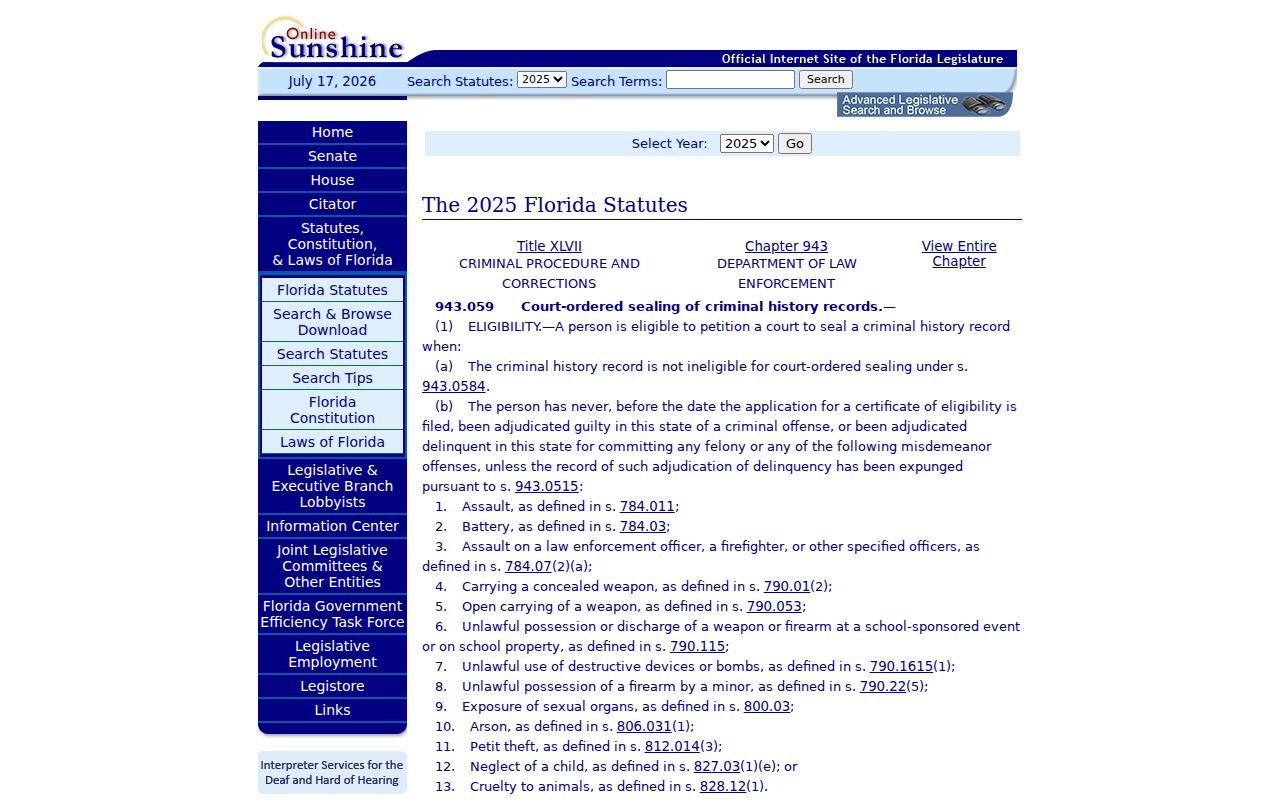
The statute image connects the city’s records path to the state rules that can restrict later public disclosure.
A person normally starts with a certified disposition from the Clerk, then seeks an FDLE Certificate of Eligibility before petitioning the original court. The certificate is not itself a sealing order. When an order is entered, each affected custodian must process it under Florida law.
Public Access Rules in High Springs
High Springs police records fall under Florida’s broad public-record baseline, but access is not absolute. Active criminal investigative information can be exempt. Juvenile information, victim-identifying material, sealed or expunged records, and other protected data may be withheld or redacted. A denial should identify its legal basis. Requesters can ask for the nonexempt portion rather than treating one protected passage as a reason to withhold the whole file.
The Legislature’s Florida Public Records Law provides the main statutory framework for inspection, copies, exemptions, and permissible charges.
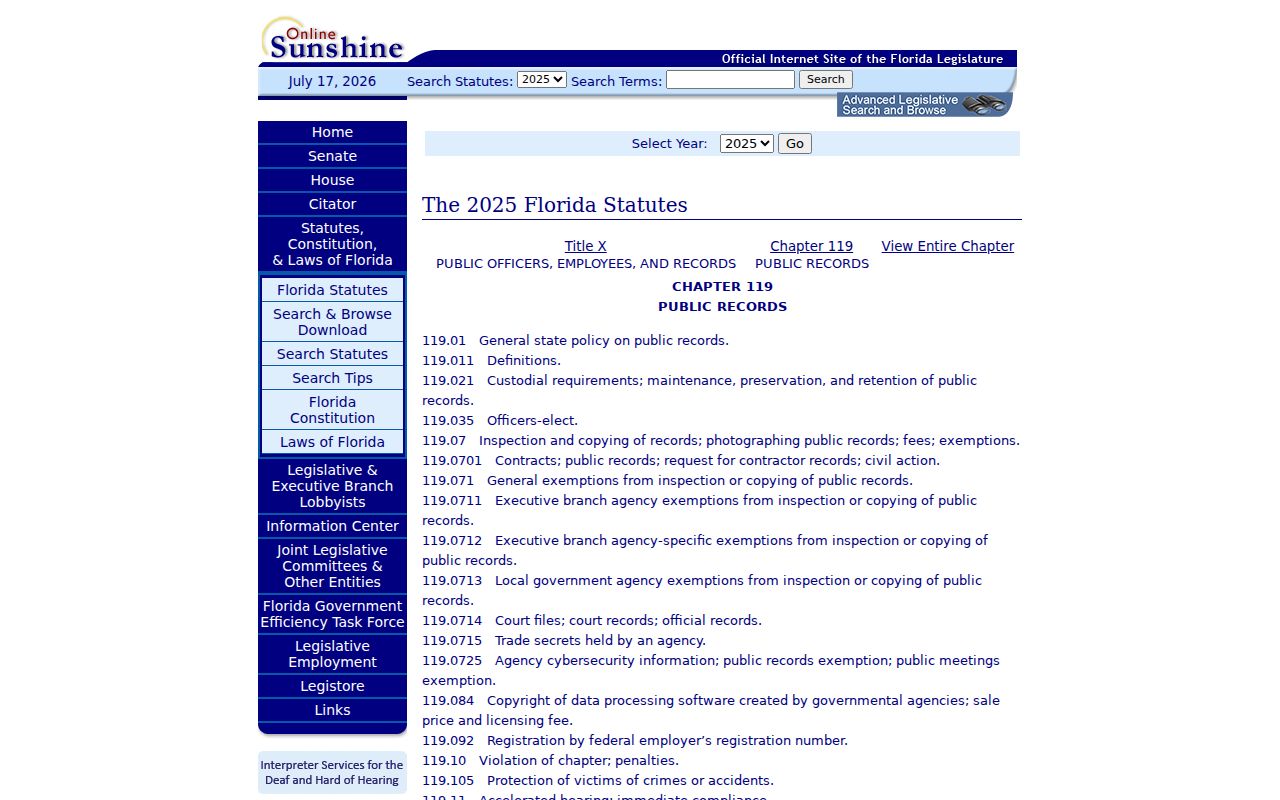
The public-record statute matters at every point where HSPD, the jail, or the Clerk evaluates a request for releasable material.
Key Statutes:
Chapter 119, Florida Statutes defines public records and governs access, copying, exemptions, and enforcement.
Florida Statutes section 943.053 governs dissemination of criminal-history information.
Florida Statutes section 985.04 protects juvenile justice records under its confidentiality rules.
Describe the existing High Springs record, ask for electronic delivery, and request an itemized estimate before costly work begins. If HSPD does not hold the item, confirm whether ACSO, the Clerk, or FDLE created the record instead.