
Alachua County Criminal Court Cases
Alachua County sits in Florida's Eighth Judicial Circuit. Circuit Court receives felony prosecutions. County Court handles misdemeanors and criminal traffic within its jurisdiction. The State Attorney decides which charges to file, judges rule on the case, and the Alachua County Clerk maintains the official case file. That split matters because a police report, a jail booking, and a court case are separate records held by different custodians.
Uniform case numbering began in 1999. The local Clerk search has an unusual rule: omit the Alachua county-code prefix "01" when entering a case number. A search result should identify the court or division, filing date, status, parties, and docket. The word closed describes the docket's procedural state, not its outcome. A closed Alachua County case may end in dismissal, acquittal, a plea, or a judgment.
Felony and Misdemeanor Courts
Florida uses offense degrees rather than letter classes. Capital, life, first-degree, second-degree, and third-degree felonies belong in Circuit Court. First-degree and second-degree misdemeanors generally belong in County Court. A case can still change course. Prosecutors may decline a booking charge, amend a count, or file a different offense after reviewing the arrest report.
The courthouse record is therefore the best source for the filed accusation and final result. The Eighth Judicial Circuit describes the local court structure, while the Clerk supplies the case record. City police departments do not keep the prosecution docket even when their officers made the arrest.
Searching Alachua County Case Records
The free Clerk search is the main public route. Start broad. Too many criteria can hide a valid match when a name, filing date, status label, or case format differs from an assumption. The index includes very old entries, but online criminal document images generally begin in December 2005. An indexed event without a PDF does not mean the file is missing.
- Open the Clerk's Court Records Search and begin with the person's last and first names.
- Add a filing-date range only when a common name returns too many results.
- For a known number, omit the leading county code "01" in the local field.
- Open the case header, compare identifiers, and read the docket from oldest event to newest.
- Request unavailable or certified documents from the Clerk rather than treating a missing image as a missing record.
| Field Label | Type | Required | Notes |
|---|---|---|---|
| Last Name | Text | Conditional | Best broad starting field |
| First Name | Text | No | Narrows the surname result |
| Middle | Text | No | An initial may be used |
| Case Number | Text | No | Omit the "01" county prefix |
| Date Filed | Date range | No | Use after a broad name search |
| Party or Status | Filter | No | Limited and needs another criterion |
Older Alachua Criminal Files
Three dates describe different kinds of access. The oldest indexed case reportedly dates to 1928. Many closed criminal files before 1990 require research at the Records Department. Public criminal document images generally begin in December 2005. Those facts should not be compressed into a claim that every old Alachua County case is fully available online.
For an older case, contact the Clerk's Records Department at 201 E. University Avenue, Gainesville, FL 32601. Give the name, approximate year, case type, and any number found in the index. Ask whether the material is paper, microfilm, archived, or queued for retrieval. Requests may also go to the Clerk's public-records channel or osr@alachuaclerk.org. Court and official-record copies are listed at $1 per page.
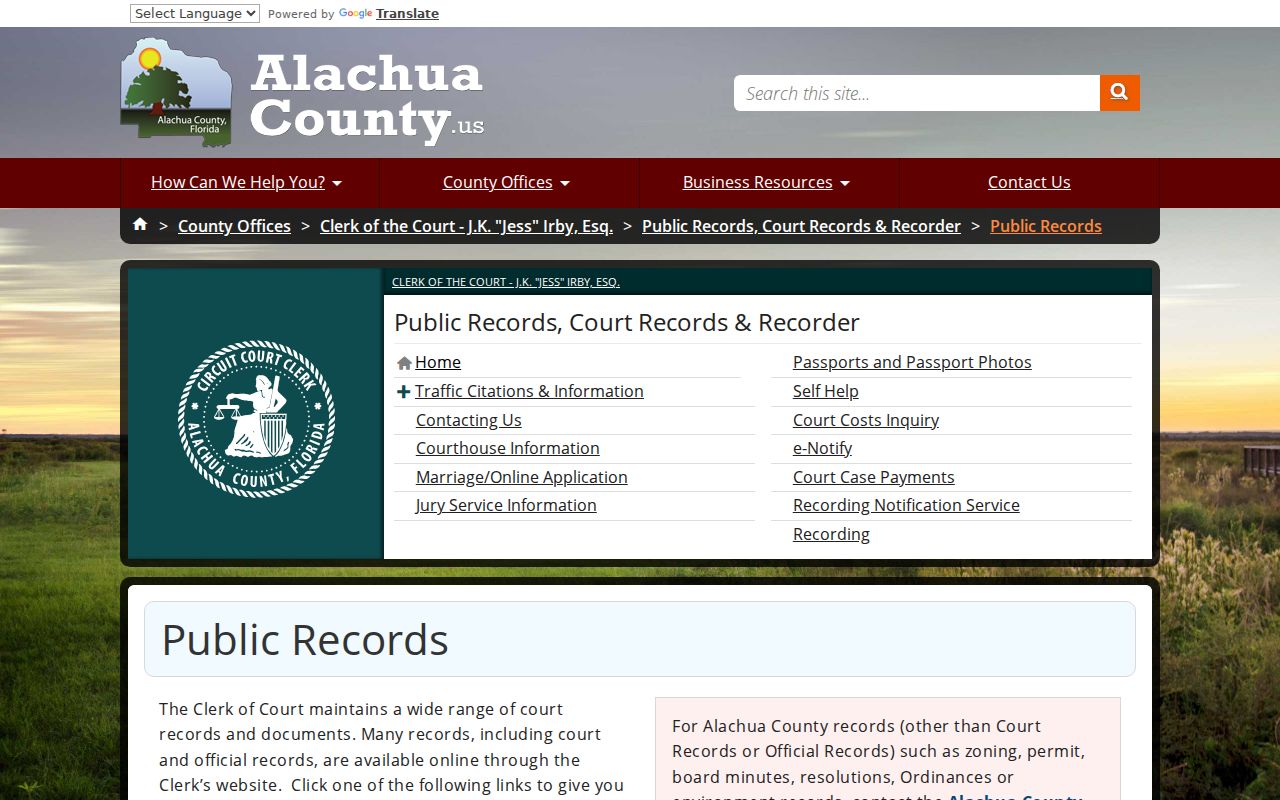
Each assigned image documents a source used for this record path. The Clerk court-records page shows where the public search begins.
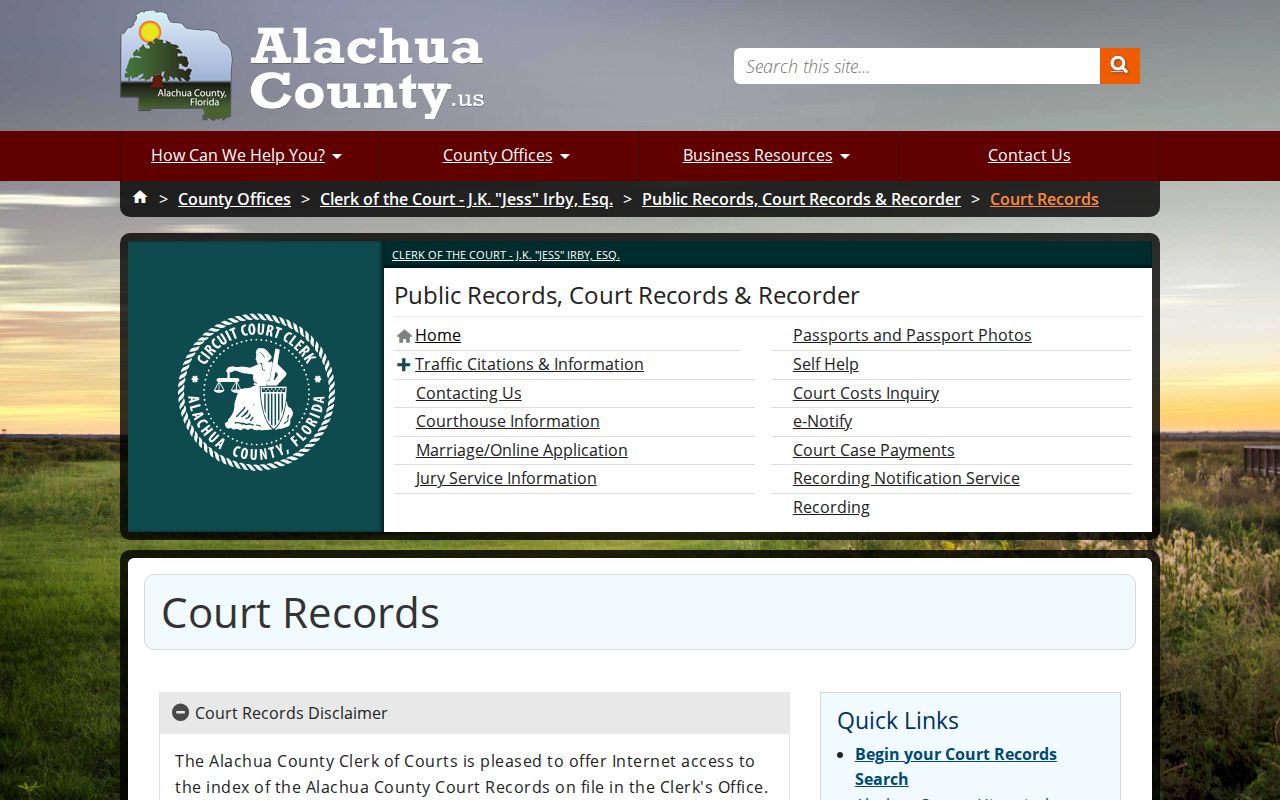
That official page is the county source to verify before relying on an index entry or requesting an older image.
Inside an Alachua County Case File
A criminal file separates the prosecutor's filed information from the original booking charge. Read the header first, then each count, the chronological docket, the disposition, and the sentencing order. Financial entries may show assessments, payments, and a balance, but the Clerk's special felony costs response does not calculate outstanding restitution.
| Case Number & Court | Uniform or local number, division, filing date, and status |
|---|---|
| Charging Document | The information or other filing that states the prosecutor's counts |
| Docket Entries | Filed motions, notices, pleas, warrants, orders, and event dates |
| Hearing Dates | Scheduled and completed court events shown on the docket |
| Disposition & Judgment | Outcome for each count, such as dismissal, acquittal, withheld adjudication, or guilt |
| Sentence & Conditions | The controlling order for custody, probation, fines, or other terms |
Reading the Alachua Docket
Read events in order. "Information filed" points to the prosecutor's formal charging document. A plea entry does not always equal the final judgment. "Nolle prosequi" means the prosecutor declined to continue a charge. Dismissal, acquittal, adjudication withheld, and adjudication of guilt have different legal effects. The latest signed judgment and sentencing order control over an early calendar entry.
- Capias
- A court process directing that a person be taken into custody.
- Nolle prosequi
- A prosecutor's decision not to proceed with a charge.
- Adjudication withheld
- A court disposition that is not the same as an adjudication of guilt.
- Disposition
- The recorded outcome of a charge or case.
The felony court-cost inquiry can return an Alachua balance breakdown by email, usually within three to five business days. It does not provide restitution totals.
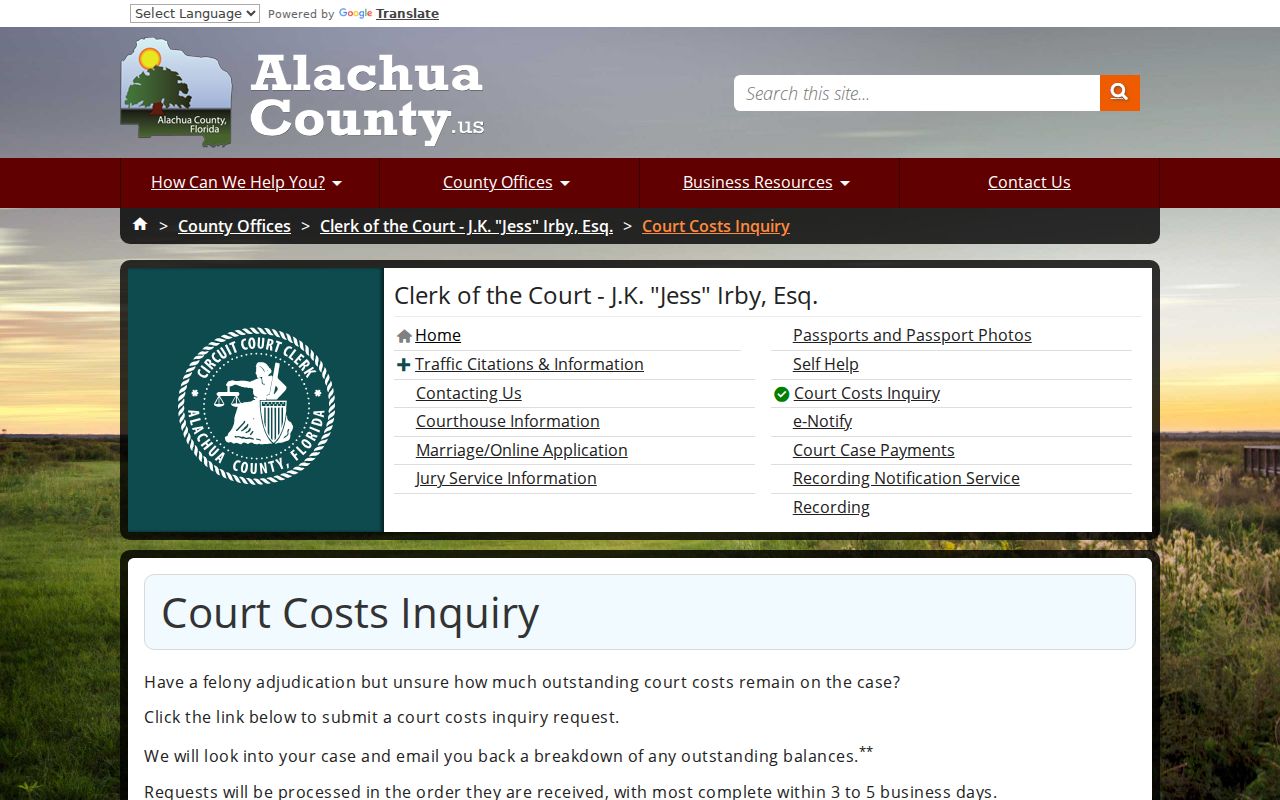
The inquiry supplements the docket's financial view; it does not replace the judgment or sentence.
How a Criminal Case Moves
An arrest may start the public trail, but it does not guarantee a filed case. The State Attorney reviews the agency report and decides what to charge. At arraignment the accused answers the filed charge. Motions, discovery notices, hearings, and plea discussions follow. A plea or trial produces a disposition, and a separate sentencing order can set custody, supervision, and financial terms.
Case flow: Charges Filed › Arraignment › Pretrial › Plea or Trial › Disposition › Sentencing
First appearance is earlier and narrower. New jail admissions appear before a judge within 24 hours, while public observers attend at the Criminal Courthouse at 220 S. Main Street rather than inside the jail courtroom. That event can address probable cause, counsel, and release conditions. It is not a trial or final outcome.
The Eighth Circuit location source documents Alachua County's judicial setting.
The circuit source helps distinguish local trial records from state and federal dockets.
Federal Cases Are Separate
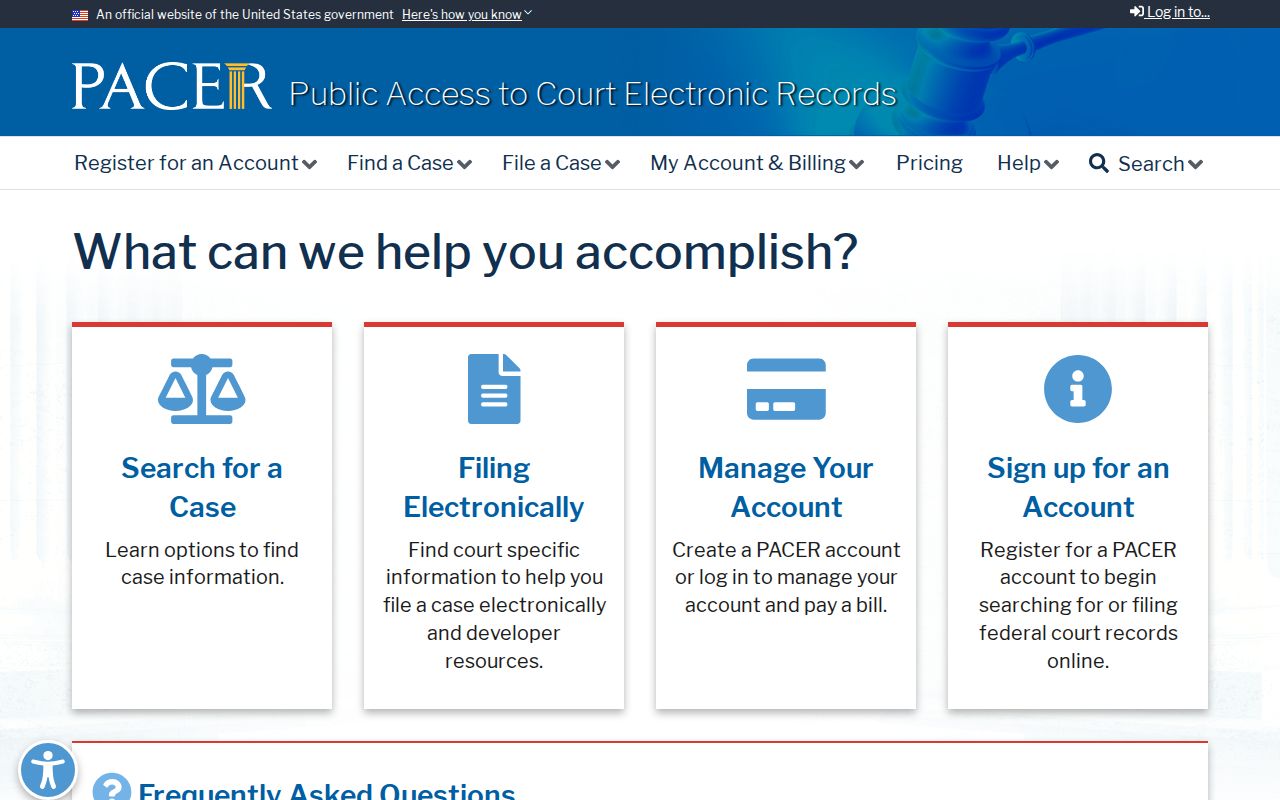
Alachua County is in the U.S. District Court for the Middle District of Florida. A county Clerk search cannot rule out a federal prosecution. Federal dockets and filed documents run through PACER, which requires registration and can charge usage fees under its current schedule. CourtListener and RECAP may hold copies contributed by users, but neither is the official complete docket.
The Middle District of Florida is the official federal court source.
Use it to confirm court locations and procedures before moving to PACER for a particular docket.
The official PACER record-access system supplies the federal docket layer shown here.
A person held on a federal matter may not appear in the Bureau of Prisons locator until designation, so custody and docket searches may not update together.
When a Court Image Is Missing
A missing PDF has several possible causes in Alachua County. The filing may predate the criminal-image boundary, the document category may be blocked from anonymous internet access, the file may need archival retrieval, or confidentiality rules may apply. First confirm that the docket event exists. Then ask the Clerk whether the item is viewable at a courthouse terminal, available as a copy, or legally restricted.
Describe the existing record instead of asking the custodian to research a legal question. A useful request includes the case number, party name, docket date, document title, and preferred electronic format. If material is withheld, request the governing authority and any releasable redacted portion. That approach separates a technical access limit from a sealed or confidential court record.
Case Record Access and Restrictions
Florida's public-access baseline comes from article I, section 24 of the state Constitution and Chapter 119. Court records also follow Florida Rule of General Practice and Judicial Administration 2.420 and Supreme Court electronic-access standards. Juvenile records, sealed or expunged cases, protected victim information, and specified confidential data do not appear like an ordinary public criminal file.
Internet access can be narrower than access at a courthouse terminal or through a direct request. If a docket event appears without an image, ask the Clerk whether the document is available another way. A person whose Social Security or account number appears in a filing can request redaction by identifying the case, document heading, and page. For a withheld record, ask for the legal basis and a segregable redacted copy.
The Clerk request instructions show the fallback channel.
A focused request by name, year, case type, and known number reduces mistaken matches and retrieval work.